

Barry Triplett doesn’t use Facebook.
So when the Tidelands Health Georgetown Family YMCA recently shared an employee spotlight about him and the comments began accumulating underneath it, Triplett had no idea what people were saying. Former players found the post. So did former colleagues, current YMCA members and people who remembered him from Pleasant Hill and Carvers Bay. Some called him “Coach Tripp.” Others called him a legend. One remembered early-morning lifeguard shifts. Another remembered hiking conversations. A woman recalled the day Barry stood beside the treadmill as she completed her first 5K after months of his encouragement.
There were nearly 60 comments by the time we finally put a phone in Triplett’s hands.
He sat scrolling through names from different chapters of his life, occasionally stopping when he recognized one. Some people he remembered immediately. Others seemed to reach so far into his years in Georgetown that even he had trouble placing them.
“Wow,” he said eventually. “A lot of people.”
The reaction was fittingly understated for someone who had spent much of the interview insisting he wasn’t sure why anyone wanted to make a fuss over him. Asked how it felt to read what people had written, Triplett said he was glad to know he had made a positive difference in their lives.
Then he admitted something.
“I didn’t realize I reached out to so many people though.”
The people of Georgetown seem to remember differently.
The coach behind the record
There are plenty of numbers available to tell the conventional version of Barry Triplett’s story. After arriving in South Carolina in the 1970s, he took over the boys basketball program at Pleasant Hill High School in 1976. Over the decades that followed at Pleasant Hill and later Carvers Bay, he won 514 basketball games, including state championships in 1985 and 1988, and his career eventually earned him recognition in two South Carolina coaching halls of fame.
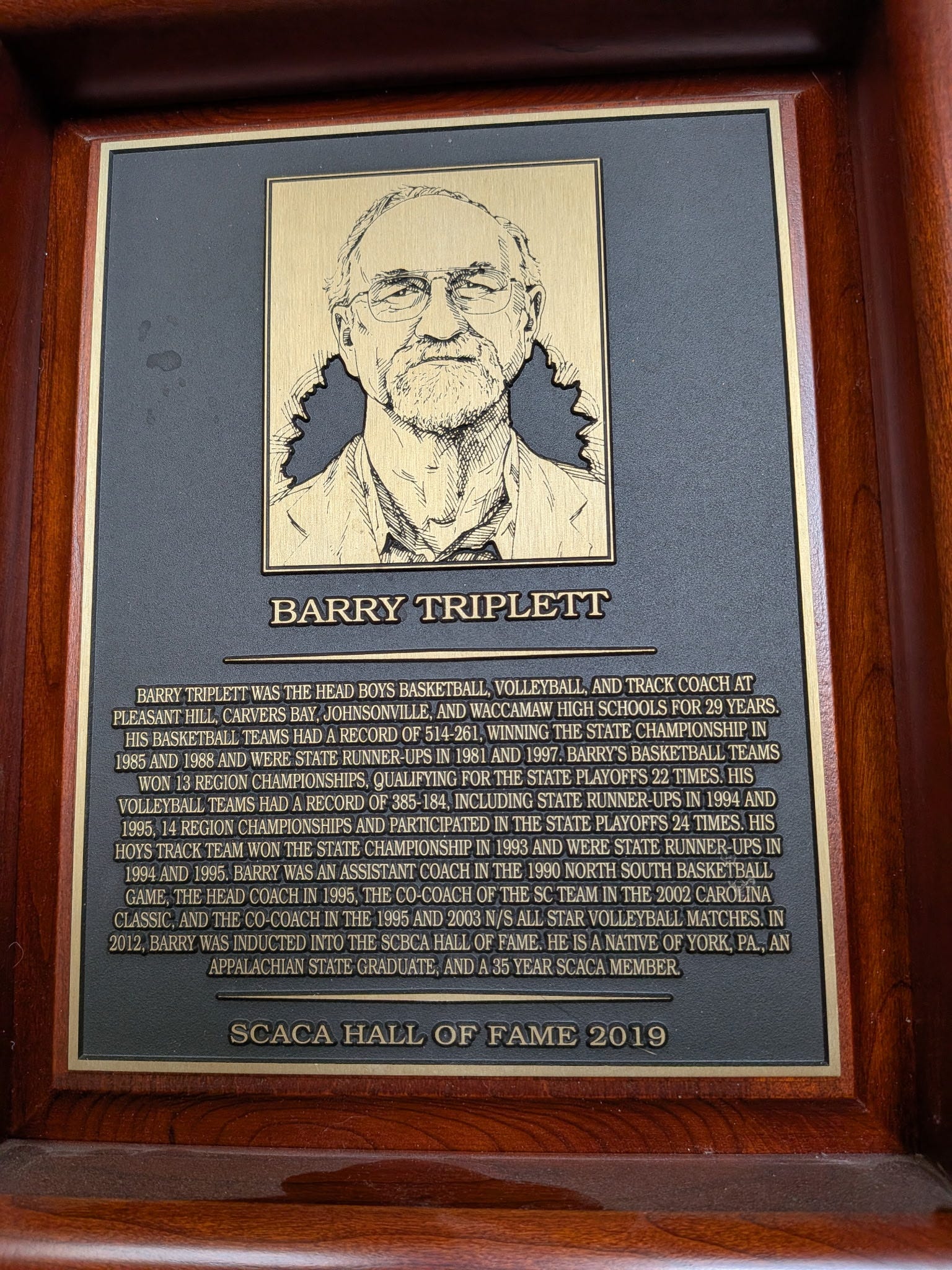
Those numbers explain why the word “legend” comes up so often when people talk about Coach Tripp. They don’t fully explain why people are still talking about him.
For that, Reggie Carr remembers a coach driving around to make sure his players had rides to and from practice. During Carr’s senior year, Triplett kept asking whether his parents planned to attend the athletic banquet. Carr didn’t know why the question mattered until he was named MVP that night. His coach had known what was coming and wanted to make sure Carr’s parents were there to see it.
The season ended. Triplett kept checking in.
“He would also check on me throughout my college years to make sure I was doing well and just stayed in touch,” Carr said.
Carr has known Triplett for more than 40 years. He describes the progression simply: he started as a fan, became one of Triplett’s players and now considers him a friend. Whatever distance life put between the old team and the basketball court in Georgetown, it didn’t erase the relationship.
That pattern repeats across Triplett’s life with remarkable consistency.
Jeff Mezzatesta arrived at Pleasant Hill at a particularly difficult time in his own. His mother had died of cancer, he was eight or nine hours from home, and he was a young teacher who loved basketball when someone suggested he introduce himself to Coach Triplett.
The connection was immediate. Triplett brought him onto his staff, and the two spent nights breaking down film, sometimes working until one or two in the morning. Mezzatesta learned how Triplett organized a program, planned practices and studied the game. What mattered most to him, however, wasn’t something he found in a playbook.
At a time when Mezzatesta was grieving and far from his own family, Barry and his wife welcomed him into theirs.
“They just sort of gave me that idea of home again,” Mezzatesta recalled.
Today, he teaches and coaches at Carvers Bay, carrying pieces of what he learned from Triplett into another generation.
“Without him, I could not have grown into who I wanted to be,” he said. “He just genuinely took people where they were and loved them.”
When the student becomes the leader
Nicole Tucker-Young can trace her own relationship with Coach Tripp back to Pleasant Hill. Her father was one of Triplett’s assistant coaches, and she knew him first as her PE teacher and later as her volleyball coach.
She can laugh now about how demanding he was. She remembers trying to cut corners while running the mile in PE and quickly learning that Triplett was paying attention. Whatever grade students received in his class, she said, they earned it. As a coach, his standard was straightforward: excellence.
What felt like a coach being demanding when Tucker-Young was a teenager looks different from where she stands today.
“Now I know that he was preparing us not just for the sport that we were playing at the time, but for life,” she said.
Triplett taught consistency. If you committed to something, you followed through. Tucker-Young remembers wanting to hurry from volleyball practice to cheer at football games and learning that her first commitment still came first. At the time, those lessons were about practice. Years later, she recognizes what else he was teaching.
“When you have a really, really good coach, sometimes you don’t value them in the moment until hindsight,” she said. “They really instilled more things in us than we thought they did at that time.”
Today, Tucker-Young is the principal of Carvers Bay Early College and Career High School. Her school’s motto is “Building Excellence and Reaching Success,” words she believes reflect what Triplett modeled for students long before she became responsible for leading them herself.
A different kind of gym
After 33 years in education, Triplett tried something entirely different. He entered a nuclear medicine program, only to discover that the work wasn’t for him. His wife suggested he look into the YMCA, where his longtime interest in fitness might be a better fit. Triplett returned to school, became a personal trainer and eventually found his way to the Georgetown Y.
That was 17 years ago.
“It’s like family,” he says today.
The setting changed, but much of the work looks familiar. Triplett still notices young people interested in basketball and offers drills. He still pays attention to the person who is trying to improve. He still believes hard work matters more than natural ability, and he still talks about what sports can teach beyond the game itself: responsibility, sacrifice and learning to work with other people.
Now, many of the people he encourages are no longer teenagers.
Triplett has a particular affection for older adults at the Georgetown Y, in part because he is one himself. He understands that staying active matters, but he also understands that sometimes what a person needs is simply somewhere to go and people who will notice when they arrive.
“You should have a place to go,” he said, “something they can do, feel better about themselves mentally and physically.”
Al Mosley has been a Georgetown YMCA member for seven years, and Barry has been part of his experience from the beginning. Mosley said Barry’s knowledge and steady support continue to motivate him to return, but he also pointed to something broader about the atmosphere Barry and his colleagues create.
“Mr. Barry and the other staff members go out of their way to make everyone feel very welcome,” Mosley wrote. “I’m happy and proud to be a part of the Georgetown YMCA family.”
For another Georgetown Y member, Nicole Wolk, Barry’s impact became clearest at a moment when exercise was the last thing on her mind.
Earlier this year, Nicole lost her mother. People tried to comfort her, but grief has a way of making words feel insufficient. Barry understood that because he had lost his mother, too. Rather than trying to find the perfect thing to say, he gave Nicole a poem that had once helped him through his own loss.
“It was the first thing that kind of brought me a little bit of peace,” she said. “I’ll never forget how Barry made me feel whenever I lost my mom.”
Years earlier, a young Jeff Mezzatesta had arrived in Georgetown grieving his own mother and found in Barry and his family what he described as “that idea of home again.” Decades later, in a YMCA Wellness Center instead of a high school gym, Barry recognized that same kind of hurt in someone else.
That may be the clearest line connecting Coach Tripp then with Barry at the Y today. He pays attention to the person in front of him.
What Georgetown remembers
The Facebook comments make that pattern difficult to miss.
Kathie Scheffing remembered Barry standing beside a treadmill with Benji Wham when she completed her first 5K. He had been encouraging her for months, she wrote, and she has never forgotten the day she finally did it.
Dale Ripley remembered being a high school basketball player and having a coach who recognized something in him before he could recognize it himself. Others wrote about seeing Barry early in the morning at the Y, about his friendliness, his encouragement and his years of service. Former players and colleagues filled the same comment section as people who know him primarily from the Wellness Center.
Their memories span decades, but they have a common language. Again and again, people describe being noticed, challenged, encouraged and remembered.
A basketball player learning that he is capable of more and a YMCA member working toward a first 5K may appear to have little in common. Barry’s story suggests otherwise. In both cases, somebody is standing nearby saying, in one way or another: keep going.
For a coach whose résumé includes 514 wins and two state championships, Jeff Mezzatesta believes that is ultimately a better measure of the career.
“You don’t measure that by wins and losses,” he said. “What measured him was relationships.”
Those relationships have had time to reveal what they built. Former players became adults and parents. Assistant coaches became head coaches. A student-athlete became a principal responsible for helping another generation grow. Some people moved away from Georgetown. Others stayed. At the Georgetown Y, new relationships continue to form between treadmills and weight machines, sometimes around fitness and sometimes around the things in life that have nothing to do with exercise.
Strong communities are built through places, programs and opportunities, but they are also built through people who keep showing up for one another. Barry Triplett has spent decades doing that in Georgetown, first from the sidelines and now from the Wellness Center floor.
When asked whether the people he once taught and coached still call him Coach Tripp, Barry didn’t hesitate.
“Anybody that I taught or coached — Coach Tripp,” he said.
Then he summed up nearly half a century in Georgetown more efficiently than anyone else could.
“Once a coach, always a coach.”
Building Community.
At the YMCA of Coastal Carolina, community is built through relationships that help people feel known, supported and connected — and give each generation the opportunity to invest in the one that follows.
That’s what building the future of our community looks like: people showing up for people, year after year.


